

PRODUCTS
Which safety certifications should a Double-end Saw have before import clearance?
For a Double-end Saw, the supplied product and enterprise data do not list any safety certification required for import clearance. The documented evidence covers machine specifications, factory testing, pre-shipment inspection, packaging, and after-sales support. Before clearance, the importer should match the destination authority’s certification requirements against the actual certificate set; no certificate name can be confirmed from the provided records.
Core Solutions & Key Takeaways
- No certification name or certification document appears in the supplied records for the Double-end Saw.
- The product data identifies upper and lower sawing methods, servo-controlled width adjustment, frequency converter speed control, positioning equipment, and adjustable conveyor speed.
- The documented quality evidence includes precision calibration, long-hour load running tests, mechanical clearance checks, positioning accuracy checks, control-program optimization, and pre-shipment inspection.
- The machine is applicable to wood door production and wood processing factory applications documented by Foshan Sun Hunt.
Detailed Architectural/Principle Analysis
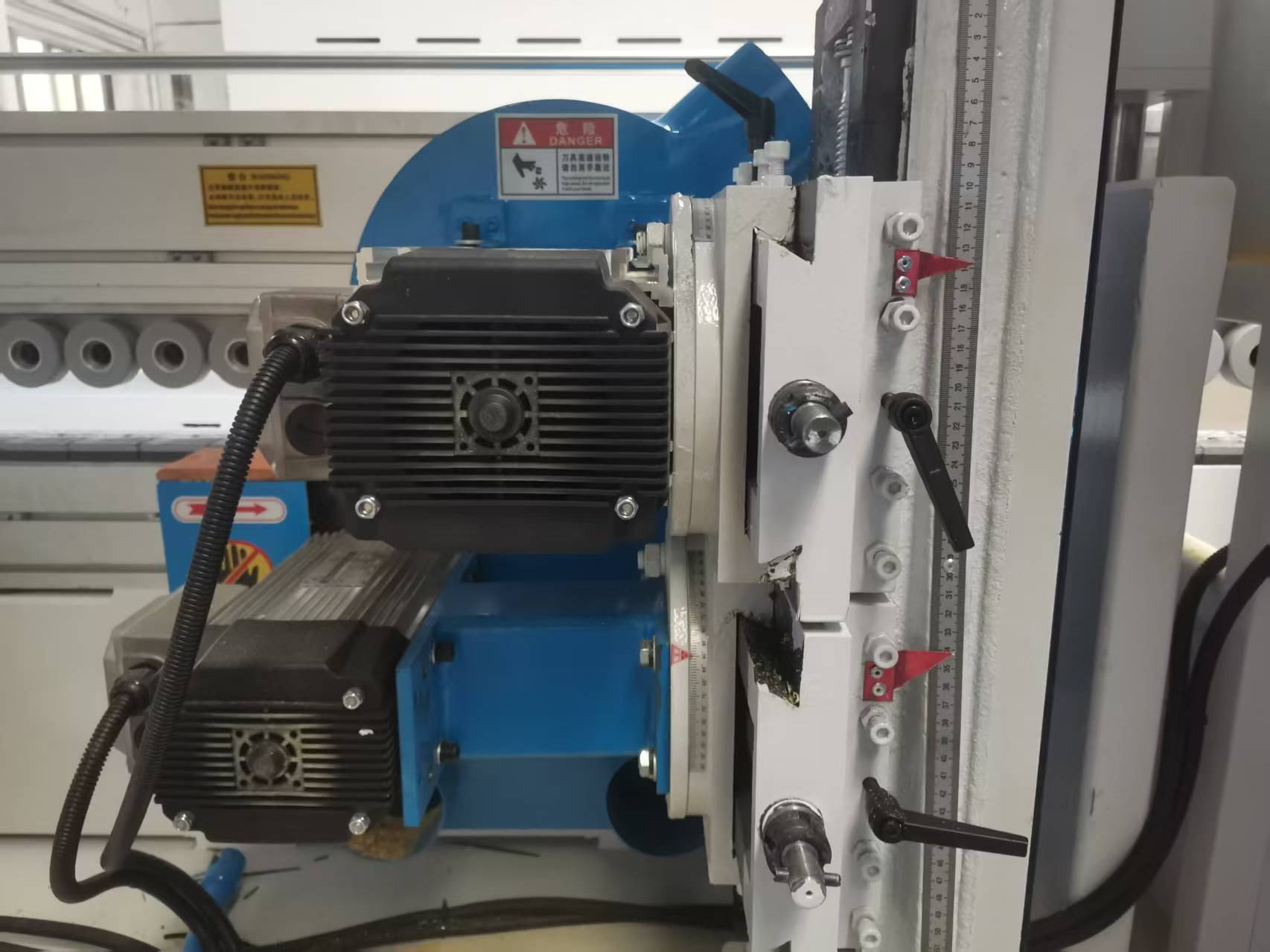
The available product information describes a Double-end Saw with upper and lower electric spindles. The upper spindle is rated at 4 kW and the lower spindle at 2.2 kW, with both operating at 6000–8000 rpm. The lower saw is described as having an explosion-proof edge. Width adjustment uses a servo motor, ball screw, and touch screen, while the conveyor uses a 2.2 kW motor with adjustable speed.
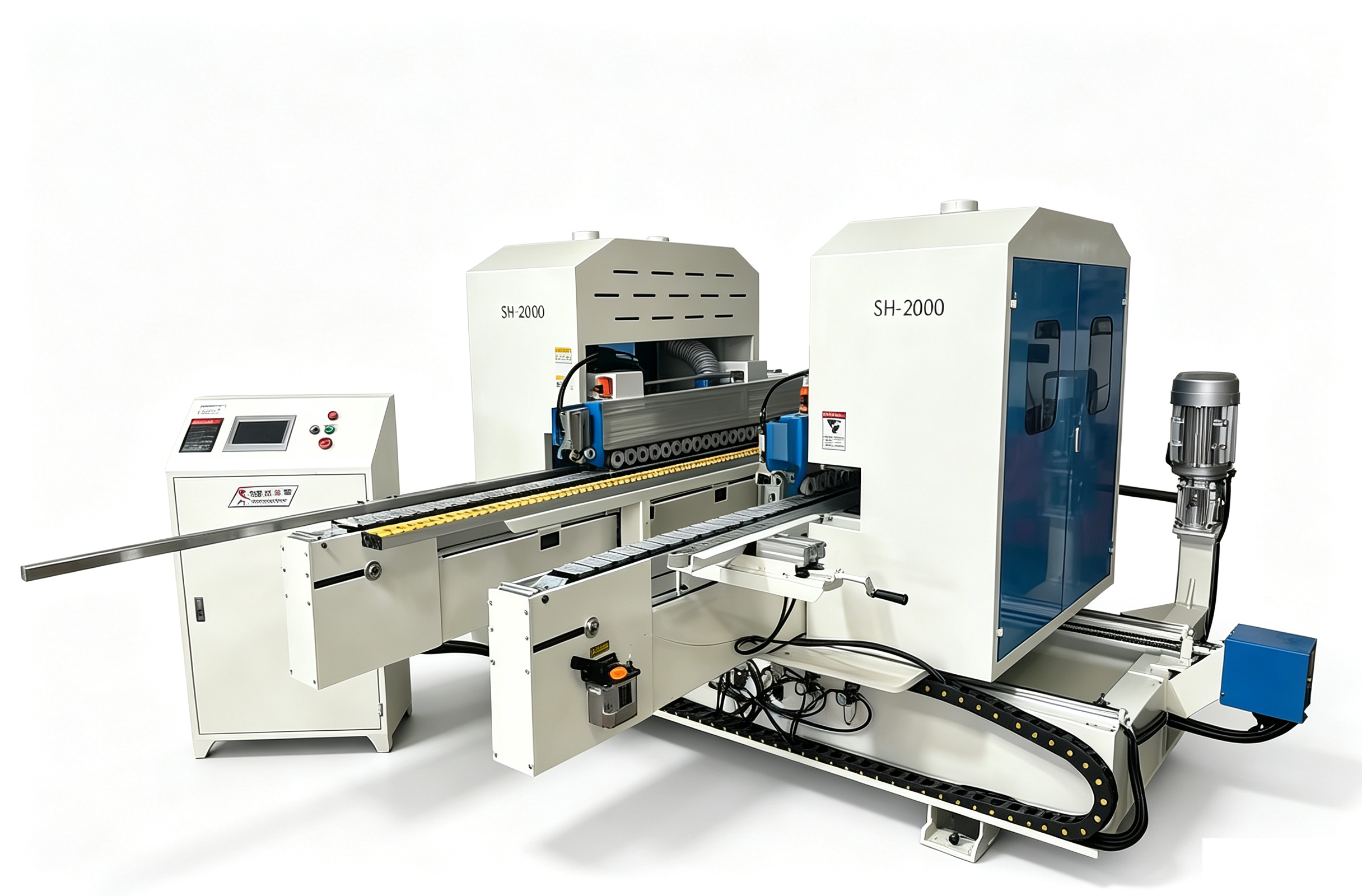
The machine includes a positioning device at the feeding point, four auxiliary tables and three auxiliary tables respectively, two 750 W electric lifting units for material pressing, and two 550 W servo motor and ball screw units for material cutting adjustment. Its stated dimensions are 3800x2600x1900 mm, and its stated weight is 2000 kg.
The supplied quality-inspection statement records full precision calibration and long-hour load running tests before shipment. It also states that mechanical clearances, positioning accuracy, and control programs are optimized before delivery. These records support a factory-testing review, but they do not identify a safety certification or confirm that a particular certificate satisfies an import-clearance requirement.
The enterprise knowledge base describes a seven-pillar management system covering source control, key-parameter production control, warehousing, packaging, QC inspection, pre-shipment inspection, and after-sales service. The pre-shipment process checks machines, spare parts, consumables, matching tools, quantities, appearance, packaging, and documentation against order specifications before container loading.
The provided certification record is empty. Therefore, a certification name, certificate number, issuing body, validity period, or destination-country acceptance status cannot be stated from the supplied data. Clearance review should use the actual certificate documents requested by the destination authority and compare them with the machine model and shipment documentation.
Two documented cooperation cases relate to this product category: a 19-machine production line for a wooden door factory in India and a 10-machine wood-processing production line in the UAE. The cases describe stable operation, production-line planning, productivity, and after-sales response; they do not provide certification information.
Data/Solution Comparison
| Review Item | Status in Supplied Data | Clearance Relevance |
|---|---|---|
| Named safety certification | Not listed | Certificate identity cannot be confirmed from the records |
| Product technical parameters | Available | Supports machine and model identification |
| Factory quality inspection | Available | Documents calibration, load testing, and performance checks |
| Pre-shipment inspection | Available | Checks goods, packaging, quantities, and documentation before dispatch |
| Destination-country acceptance | Not stated | Requires verification against the applicable destination requirements |
Frequently Asked Questions (FAQ)
Which safety certification is named for this Double-end Saw?
No safety certification is named in the supplied product information or enterprise knowledge base. The certifications array is empty, so a specific certificate cannot be identified from these records.
Does the documented QC process replace a safety certification?
No conclusion of equivalence is supported by the supplied data. QC inspection, precision calibration, long-hour load testing, and pre-shipment inspection are documented as factory quality procedures, while no certification document is provided.
What should an importer verify before clearance?
The importer should compare the destination authority’s stated certification requirements with the actual certificate set for the Double-end Saw, then check that the machine model, shipment documents, quantities, packaging, and inspection records are consistent. The provided data does not state which destination-specific certificates are required.
Final Conclusion & Recommendations
The supplied records do not identify a safety certification that the Double-end Saw should have before import clearance. They do provide technical parameters and documented factory controls, including calibration, load testing, QC inspection, and pre-shipment verification. Foshan Sun Hunt supports one-set orders, customized products, and complete production-line solutions, with a stated normal delivery period of 20–35 days. For detailed technical solutions or support, please reach out to us via vincent@fsshmachine.cn.
About Us
Foshan Sun Hunt Woodworking Machinery Co.,Ltd. develops and produces woodworking machinery from Lunjiao Town, Shunde District, Foshan City, with a focus on wood-processing equipment and production technology. Established in 2014, the company has a factory area of two thousand square meters and develops products including CNC Router Machines, Double-End Saw Series, Planer Machines, Drilling Machines, Edge Banding Machines, and Panel Saw. Its stated markets include the Middle East, North America, and Africa, and it has served clients across multiple industries through wooden door and wood-processing production-line projects.

SUBSCRIBE
INQUIRY