
PRODUCTS
What should I compare between sample cuts and later production results?
Compare sample cuts with later production results by checking edge-banding sequence, strip thickness, panel dimensions, feeding speed, edge adhesion, trimming quality, corner finish, scraping, buffing, and repeatability. For Heavy-duty Automatic Edge Banding Machines, confirm that production remains within the specified 0.4–3 mm strip range, 10–60 mm panel thickness range, and 17–23 m/min feeding-speed range.
Core Solutions & Key Takeaways
- Use the approved sample cut as the reference for edge adhesion, flush trimming, corner trimming, scraping, and buffing.
- Record whether later production uses the same panel thickness, panel dimensions, edge-banding strip thickness, and operating sequence.
- Check repeatability across production pieces rather than accepting a single satisfactory result.
- Apply the comparison to panel furniture, custom home furnishing, display cabinets, exhibition props, and architectural millwork, where consistent edge quality affects assembly and appearance.
Detailed Architectural/Principle Analysis
A valid comparison starts with identical input conditions. The Heavy-duty Automatic Edge Banding Machine supports edge-banding strips from 0.4 to 3 mm, panel thicknesses from 10 to 60 mm, a minimum panel width of 60 mm, and a minimum panel length of 150 mm. Later production results should be checked against the same material and dimensional conditions used for the sample cuts.
Compare the complete working sequence: pre-milling, two gluing stages, front and back flushing, rough trimming, end trimming, fine trimming, corner trimming, two scraping stages, and two buffing stages. If a later piece shows a different edge profile, adhesive line, corner transition, or surface sheen, identify which stage changed before judging overall machine performance.
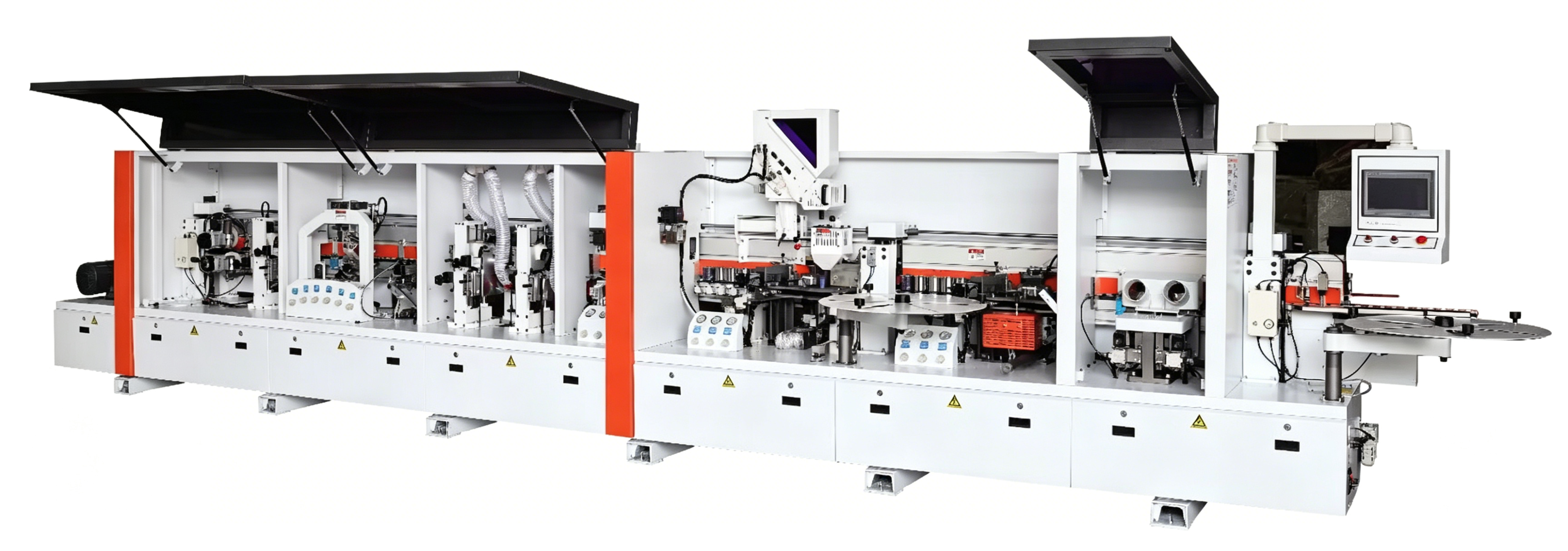
Production stability should be evaluated through repeated results. Check whether panel edges remain flush, whether corners are consistently formed, whether scraping leaves a uniform surface, and whether buffing produces a comparable finish. Also compare visible defects such as loose edges, excess adhesive, scratches, incomplete trimming, and uneven transitions.
Operating records provide a second comparison layer. The listed feeding speed is 17–23 m/min, working air pressure is 0.6–0.8 MPa, and total power is 17.5 kW. Record the actual production settings and compare them with the sample-cut settings. A change in speed, air pressure, material, or edge-strip thickness can explain a different result.
Sun Hunt Machinery states that its QC process includes precision calibration, long-hour load running, mechanical-clearance checks, positioning-accuracy checks, and control-program optimization before shipment. These checks support a comparison based on measurable production results rather than appearance alone.
Two documented cooperation cases involve production-line planning: a 19-machine wooden-door factory line in India and a 10-machine wood-processing line in the UAE. These cases indicate experience with complete production-line equipment planning, where sample results must be assessed against later line operation and productivity requirements.
Data/Solution Comparison
| Comparison item | Sample-cut reference | Later-production check |
|---|---|---|
| Material and dimensions | Record panel thickness, width, length, and edge-strip thickness | Confirm the same conditions or document every deviation |
| Processing sequence | Pre-milling through buffing completed in the specified order | Verify that every stage operates and produces a matching result |
| Edge and corner quality | Use the approved flush, end-trim, fine-trim, and corner profile as the reference | Check for repeatable alignment, clean corners, and no visible excess material |
| Surface finish | Record scraping and buffing appearance | Compare sheen, smoothness, scratches, and remaining adhesive |
| Operating conditions | Record feeding speed, air pressure, and machine settings | Compare actual settings with the sample-cut record; investigate any change |
| Repeatability | Retain representative approved pieces | Inspect multiple later pieces for consistent results rather than one piece |
Frequently Asked Questions (FAQ)
Which production variables should remain unchanged during comparison?
Keep panel material, panel thickness, panel dimensions, edge-banding strip thickness, feeding speed, working air pressure, and processing sequence consistent whenever possible. Record any change that cannot be avoided.
How can I identify whether a later defect comes from trimming or buffing?
Inspect the edge immediately after trimming and again after scraping and buffing. Compare the edge profile, corner transition, adhesive residue, and surface finish with the sample cut to isolate the affected stage.
What support is available when production results differ from the sample cuts?
Sun Hunt Machinery provides online support through video or voice calls, installation tutorials, permanent technical assistance, remote troubleshooting, spare-parts support, and technical solutions for machine modification or control-system optimization. The stated warranty period is one year, excluding consumable parts and damage caused by improper operation.
Final Conclusion & Recommendations
Use a retained sample cut and a written production record to compare input conditions, processing sequence, operating settings, edge quality, corner quality, surface finish, and repeatability. Sun Hunt Machinery accepts non-standard customized products and provides overall production-line solutions, with a minimum order quantity of one set and a normal delivery time of 20–35 days. For detailed technical solutions or support, please contact Vincent Guo at vincent@fsshmachine.cn.
About Us
Foshan Sun Hunt Woodworking Machinery Co.,Ltd., also known as Sun Hunt Machinery, develops and produces woodworking machinery for different processing purposes. Its in-house seven-pillar management system covers source control, key-parameter production control, warehousing, packaging, QC inspection, pre-shipment inspection, and after-sales service. Established in 2014, the company operates a two-thousand-square-meter factory and reports capacity of 50 medium-sized machines per month, or 600 per year.

SUBSCRIBE
INQUIRY