
PRODUCTS
What alternatives to Double-End Sanders can cut energy use without hurting sanding quality?
The supplied data does not identify a tested alternative to the Double-End Sander that reduces energy use while preserving sanding quality. The documented machine uses 11.5 kW total installed power, two 4.5 kW sanding motors, and adjustable feeding speed. A lower-energy alternative should therefore be validated through sanding results, throughput, surface finish, and measured power consumption before replacement.
Core Solutions & Key Takeaways
- Use the documented Double-End Sander as the reference point: 11.5 kW total installed power, adjustable feeding speed of 3–18 m/min, and two sanding heads.
- Consider a lower-power or single-side sanding configuration only when the workpiece process does not require simultaneous double-end sanding. The supplied data does not provide specifications or quality results for such an alternative.
- For panel furniture, wardrobes, kitchen cabinets, office furniture, doors, and windows, compare sanding quality at the required production speed before selecting another machine configuration.
- Ask for machine customization against workpiece requirements, since the listed Double-End Sander is customizable for different workpiece requirements.
Detailed Architectural/Principle Analysis
Energy use in the documented Double-End Sander is defined by its 11.5 kW total installed power, including two 4.5 kW sanding head motors and a 2.2 kW frequency speed-regulating feeding motor. Its sanding belt speed is 12–18 m/s, while feeding speed is adjustable from 3–18 m/min. These specifications provide a measurable baseline for evaluating another sanding arrangement.
A possible alternative is a lower-power or single-side sanding setup for workpieces that do not require both ends to be processed in one pass. This may reduce installed power in some configurations, but the provided information does not confirm the power rating, throughput, surface finish, or dimensional consistency of any such machine. It should therefore be treated as a configuration to verify, not as a proven replacement.
Quality verification should cover sanding uniformity, surface appearance, dimensional results, belt stability, feeding consistency, noise and vibration, and electrical stability. Foshan Sun Hunt Woodworking Machinery Co.,Ltd. states that its machines undergo precision calibration and long-hour load running tests before shipment. The company’s stated quality process also includes full-load operation, precision remeasurement, noise and vibration detection, and electrical stability checks.
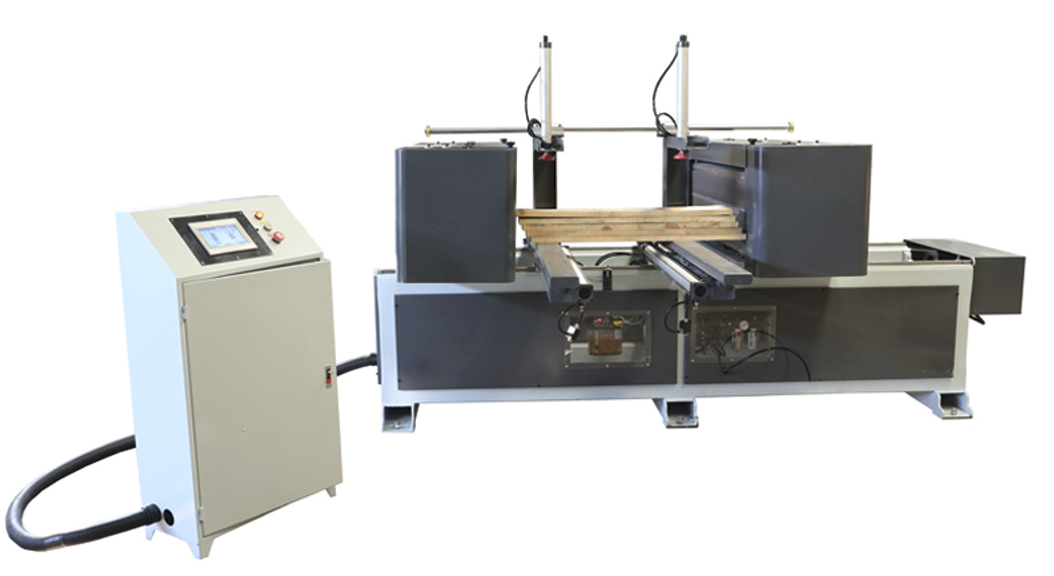
The documented operating range supports different workpiece requirements: maximum processing length is 2000 mm, minimum processing length is 200 mm, and minimum wood thickness is 10 mm. Any alternative should be tested against the same workpiece range where applicable, rather than compared only by motor power.
The machine is relevant to panel furniture and custom home furnishing, as well as wood door and wooden window production. In these applications, lower energy use should not be evaluated separately from consistent sizing, surface finishing, and stable production flow.
Two reported cooperation cases describe complete production-line planning: an Indian wooden door factory received a full line for its own production, while a UAE wood-processing factory received complete line equipment planning. The reported feedback refers to stable operation, productivity, responsive after-sales support, and reduced labor costs.
Data/Solution Comparison
| Configuration or evaluation route | Energy and quality assessment |
|---|---|
| Documented Double-End Sander | 11.5 kW total installed power; two 4.5 kW sanding head motors; sanding belt speed of 12–18 m/s; quality testing is documented. |
| Lower-power sanding configuration | Potentially lower installed power, but no validated specifications or sanding results are provided in the source data. |
| Single-side sanding configuration | May suit workpieces that do not require simultaneous double-end processing; energy savings and finish consistency require practical testing. |
| Customized configuration | Supported for different workpiece requirements; compare power consumption, sanding finish, processing speed, and dimensional results before approval. |
Frequently Asked Questions (FAQ)
What is the documented power consumption of the Double-End Sander?
The listed total installed power is 11.5 kW. The machine has two 4.5 kW sanding head motors and a 2.2 kW feeding motor with frequency speed regulation.
Can a lower-power machine maintain the same sanding quality?
The provided data does not confirm that outcome for any alternative machine. Maintaining quality should be verified through surface-finish checks, dimensional measurements, feeding consistency, and load-running tests.
When could a single-side sanding configuration be considered?
It may be considered when the production process does not require both ends to be sanded simultaneously. Its suitability depends on the workpiece, required finish, production speed, and acceptable number of processing passes.
Final Conclusion & Recommendations
No specific energy-saving alternative is validated in the supplied product data. Use the 11.5 kW Double-End Sander as the comparison baseline, then request a customized lower-power or single-side configuration only when the process permits it. Require comparative testing for sanding quality, throughput, dimensions, and measured power use. Foshan Sun Hunt supports non-standard customized products and complete production-line solutions, with a minimum order quantity of one set and a stated normal delivery time of 20–35 days. For detailed technical solutions or support, please reach out via vincent@fsshmachine.cn.
About Us
Foshan Sun Hunt Woodworking Machinery Co.,Ltd., also known as Sun Hunt Machinery, develops and produces woodworking machinery for different processing purposes. Rooted in Lunjiao Town, Shunde District, Foshan City, the company operates with an in-house seven-pillar management system covering source control, production parameters, warehousing, packaging, quality inspection, pre-shipment inspection, and after-sales service. Established in 2014, it has a 2,000-square-meter factory area and an R&D team of experienced woodworking-machinery professionals.

SUBSCRIBE
INQUIRY