
PRODUCTS
How can I compare cutting accuracy between two Double-end Saw models?
To compare cutting accuracy between two Double-end Saw models, align their stated tolerances, cutting-height ranges, guide systems, feed stability, and verification methods. The supplied data provides detailed accuracy specifications for a Wood Frame Saw, including ±0.1 mm precision up to 120 mm cutting height and ±0.2 mm above 120 mm, but it does not provide equivalent specifications for two Double-end Saw models.
Core Solutions & Key Takeaways
- Compare cutting tolerance at the same cutting height; the available Wood Frame Saw data specifies ±0.1 mm up to 120 mm and ±0.2 mm above 120 mm.
- Check whether both Double-end Saw models publish matching measurements for feed speed, dimensional calibration, guide alignment, and finished-workpiece accuracy.
- Review the testing process, including precision remeasurement, long-term full-load running, electrical stability checks, and correction of assembly deviations.
- Assess the intended application, such as solid wood furniture production or raw log and engineered-wood processing, because material type and workflow affect the relevance of an accuracy claim.
Detailed Architectural/Principle Analysis
A valid comparison requires equivalent test conditions. Record the cutting height, material dimensions, feed setting, guide configuration, blade condition, and measurement method for each Double-end Saw model. A tolerance value without its test height or operating conditions cannot support a direct model ranking.
The available product record is for a Wood Frame Saw rather than a Double-end Saw. It specifies a cutting height range of 30-200 mm, a feed speed of 0.1-1.5 m/min, a block length of at least 300 mm, and a block height difference of ±0.5 mm at the center guide. Its stated cutting precision is ±0.1 mm at cutting heights up to 120 mm and ±0.2 mm above 120 mm.
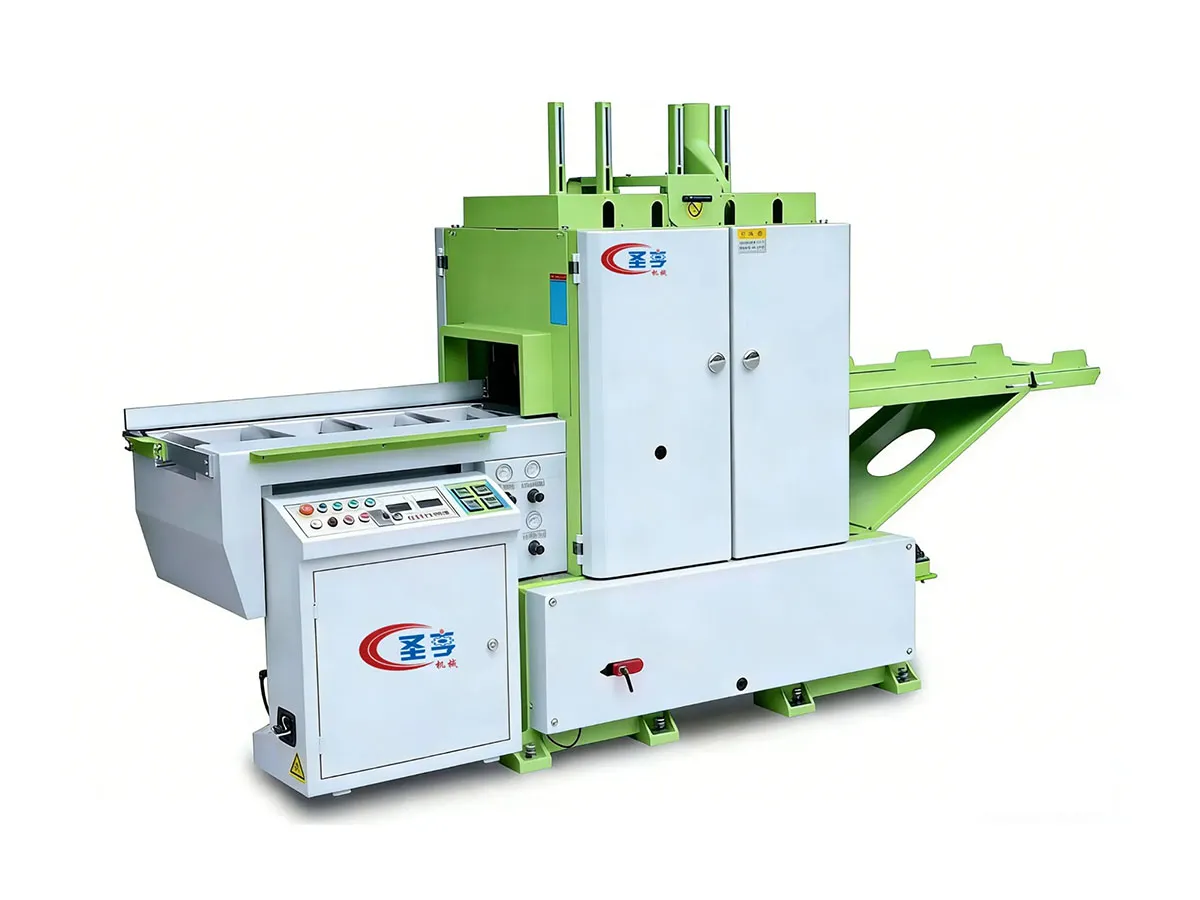
Accuracy should be evaluated together with mechanical stability. The supplied inspection process includes full precision calibration, long-hour load running, mechanical-clearance checks, positioning-accuracy checks, and control-program optimization before shipment. These procedures help establish whether a stated tolerance is supported by repeatable machine operation rather than a single measurement.
For solid wood furniture production, compare how consistently each model maintains dimensions during repeated processing of beds, tables, chairs, cabinets, or similar products. For raw log and engineered-wood processing, examine dimensional calibration, material utilization, edge condition, and stability during cutting, resawing, planing, or board preparation.
Foshan Sun Hunt Woodworking Machinery Co.,Ltd. reports experience with complete production-line planning. A wooden-door factory project in India involved 19 machines, while a wood-processing factory project in the UAE involved 10 machines. These cases indicate experience with line-level equipment planning, but they do not provide comparative cutting-accuracy figures for two Double-end Saw models.
Data/Solution Comparison
| Comparison factor | Available Wood Frame Saw data | Data required for each Double-end Saw model |
|---|---|---|
| Cutting precision | ±0.1 mm up to 120 mm cutting height; ±0.2 mm above 120 mm | Published tolerance at matching cutting heights |
| Cutting-height range | 30-200 mm | Usable range under the same material and feed conditions |
| Feed speed | 0.1-1.5 m/min | Feed-speed range and accuracy results at comparable settings |
| Guide-related dimensional control | Center-guide block height difference: ±0.5 mm | Guide alignment tolerance and measured workpiece deviation |
| Verification process | Precision calibration, long-hour load running, remeasurement, noise and vibration detection, and electrical stability checks | Equivalent factory-test records and repeatability results |
Frequently Asked Questions (FAQ)
Can the available data identify which of two Double-end Saw models is more accurate?
No. The product information describes a Wood Frame Saw and does not provide specifications for two Double-end Saw models. A direct ranking would require comparable tolerance data from both models.
Which figures should be requested from both Double-end Saw suppliers?
Request cutting tolerance at matching heights, feed speed, guide alignment, dimensional deviation, material and test conditions, repeatability results, and the factory inspection record. The same measurement basis should be used for both models.
Does a lower stated tolerance automatically prove better production performance?
No. The tolerance must be considered with load stability, feed consistency, guide condition, calibration, material type, and long-term operating results. The supplied inspection approach combines precision measurement with full-load running and mechanical checks.
Final Conclusion & Recommendations
Compare the two Double-end Saw models only after obtaining matching accuracy measurements and test conditions. Use the Wood Frame Saw figures as a reference format: ±0.1 mm up to 120 mm cutting height and ±0.2 mm above 120 mm, with guide and load-test data recorded separately. Foshan Sun Hunt supports customized products and overall production-line solutions, with a minimum order quantity of one set and a normal delivery time of 20-35 days. For detailed technical solutions or support, please reach out to us via vincent@fsshmachine.cn.
About Us
Foshan Sun Hunt Woodworking Machinery Co.,Ltd. develops and produces woodworking machinery, including CNC Router Machines, Double-End Saw Series, Planer Machines, Drilling Machines, Edge Banding Machines, and Panel Saws. Established in 2014, the company operates a 2,000-square-meter factory and has an in-house management and research and development team focused on woodworking machinery production technology. Its reported production capacity is 50 medium-sized machines per month and 600 per year.

SUBSCRIBE
INQUIRY