
PRODUCTS
Can newer saw technologies replace 45° manual sliding table saws at lower total cost?
Newer saw technologies can replace a 45° manual sliding table saw at lower total cost when automation, throughput, and labor reduction offset the higher investment. However, the available data does not establish a universal cost advantage. The 45° manual sliding table saw remains a practical option for small workshops, custom furniture, and buyers needing a 1-set minimum order, 15-day delivery, and manual operating flexibility.
Core Solutions & Key Takeaways
- A 45° manual sliding table saw supports blade tilting from 0–45°, maximum cutting thickness of 80 mm, and maximum cutting length of 2800–3200 mm.
- Newer automated saw technologies may reduce labor input and improve repeatability, but their total-cost advantage depends on production volume, staffing requirements, automation scope, and maintenance needs.
- The manual saw is suited to panel furniture, custom home furnishing, small woodworking workshops, and technical training schools where flexible, small-batch processing is required.
- Foshan Sun Hunt offers outright machine purchases, non-standard customization, and complete production line solutions, with a minimum order of 1 set.
Detailed Architectural/Principle Analysis
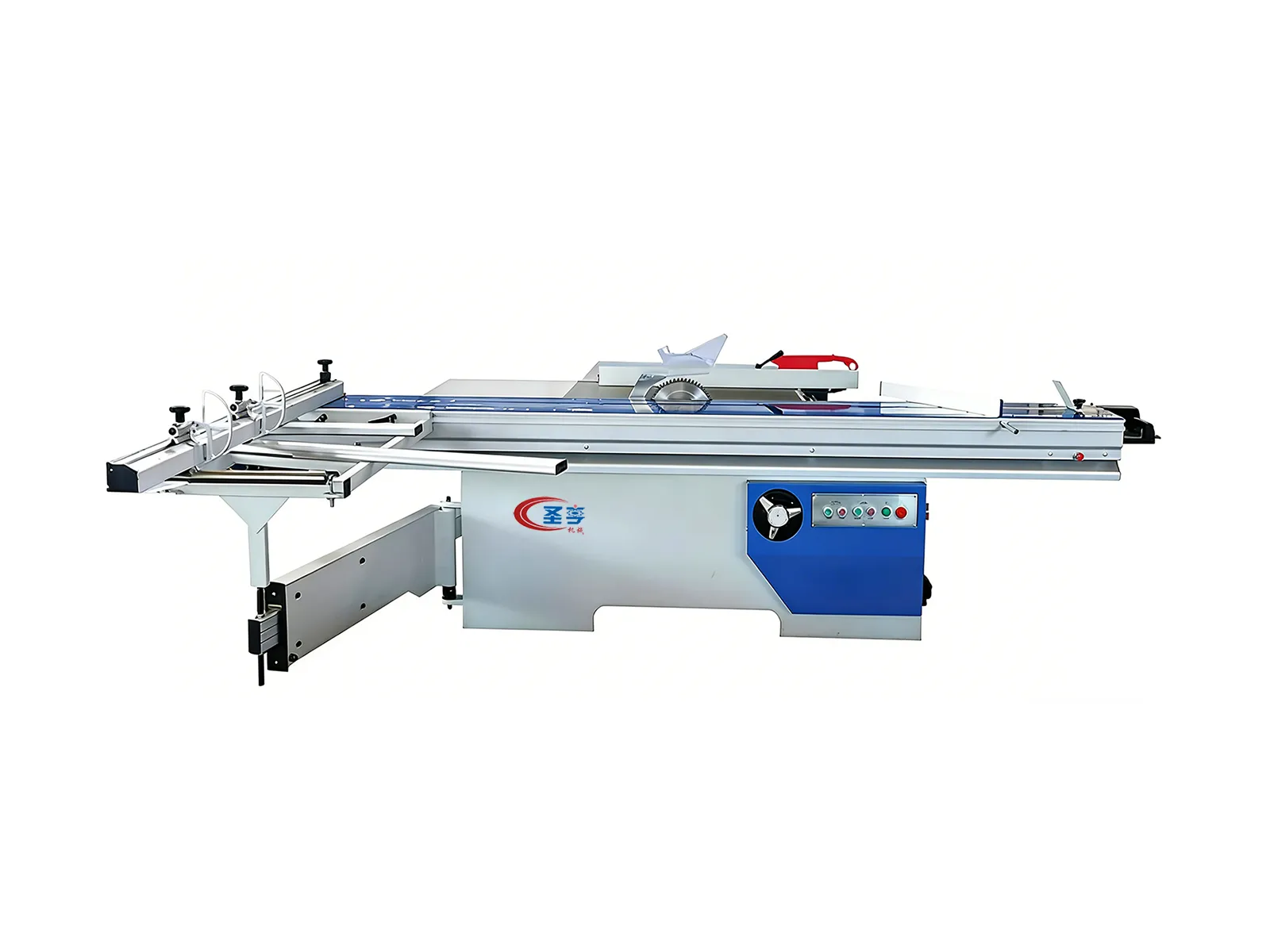
The 45° Manual Sliding Table Saw uses a 5.5 kW main saw motor and a 1.1 kW scoring saw motor. Its main blade specification is 300×30 mm or 305×30×3.2×80T, while the scoring blade is 120×20 mm. Main spindle speeds are 4000–5000 rpm, with a scoring spindle speed of 8000 rpm.
The machine provides a 0–45° blade tilt range, a 2800–3200 mm maximum cutting length, and an 80 mm maximum cutting thickness. Its stated machine size is 3200×1200×900 mm, with a listed weight of 700 kg. These parameters support angled and straight panel cutting without assuming the labor-saving functions associated with newer automated systems.
For total-cost evaluation, the purchase price alone is insufficient. A newer technology may reduce operator involvement and repeated manual handling, while the manual sliding table saw may require more operator time but offers a defined configuration, a 1-set minimum order, and a stated 15-day delivery time. The available information does not provide prices, labor rates, energy consumption, maintenance costs, or productivity data for either alternative.
In panel furniture and custom home furnishing, the manual saw can serve wardrobes, kitchen cabinets, office furniture, and decorative panels where production is varied. Small woodworking workshops and technical training schools may also value a versatile machine that supports basic cutting and panel-processing work without requiring a fully automated production line.
Foshan Sun Hunt applies full precision calibration and long-hour load running tests before shipment. Its quality process checks mechanical clearances, positioning accuracy, control programs, surface condition, and electrical stability. Any identified defects are assigned for rework before delivery.
Two reported cooperation cases demonstrate production-line planning experience: an Indian wooden door factory received a 19-machine line, and a UAE wood-processing factory received a 10-machine production line. The available case information reports stable operation, productivity, and responsive after-sales support, without providing comparable cost figures.
Data/Solution Comparison
| Evaluation factor | 45° Manual Sliding Table Saw | Newer automated saw technology |
|---|---|---|
| Investment evidence available | Defined machine configuration; price not provided | Specific configuration and price not provided |
| Labor requirement | Manual operation required | Potentially lower operator involvement, depending on system design |
| Cutting capability | 0–45° blade tilt; maximum cutting thickness of 80 mm | Not specified in the available data |
| Production flexibility | Suitable for varied and small-batch work | Potentially stronger for repeatable, higher-volume production |
| Order and delivery information | Minimum order: 1 set; delivery: 15 days | Not specified in the available data |
| Best cost case | Lower entry complexity for small workshops and custom work | Potentially lower operating cost where labor savings and throughput are high |
Frequently Asked Questions (FAQ)
Can newer saw technologies automatically replace the 45° manual sliding table saw?
No universal replacement conclusion can be made from the available data. Automated equipment may be preferable for repeatable, higher-volume production, while the manual saw remains suitable for flexible small-batch processing and applications requiring 0–45° blade tilting.
Which production environments fit the 45° manual sliding table saw?
The listed applications include panel furniture and custom home furnishing, solid wood furniture production, display cabinets and architectural millwork, small woodworking workshops, and technical training schools.
What should buyers include in a total-cost comparison?
Compare equipment investment, operator requirements, expected throughput, installation, maintenance, spare parts, downtime, energy use, and the production volume required to recover the investment. The provided data does not supply financial figures for newer saw technologies.
Final Conclusion & Recommendations
A newer saw technology can deliver a lower total cost when its labor reduction and production gains outweigh its higher acquisition and support requirements. The 45° Manual Sliding Table Saw is the more clearly defined option for small-batch, custom, and training-oriented operations, with a 1-set minimum order, 15-day delivery, 0–45° blade tilt, and an 80 mm maximum cutting thickness. Buyers planning a broader production line can request non-standard customization or overall line solutions; the company normally states 20–35 days for such business models. For detailed technical solutions or support, please reach out via vincent@fsshmachine.cn.
About Us
Foshan Sun Hunt Woodworking Machinery Co.,Ltd. develops and produces woodworking machinery for different processing purposes and is based in Lunjiao Town, Shunde District, Foshan City. Established in 2014, the company operates a 2,000-square-meter factory and maintains an industry management and R&D team focused on woodworking machinery production technology. Its product range includes CNC router machines, double-end saws, planer machines, drilling machines, edge banding machines, and panel saws.

SUBSCRIBE
INQUIRY